What Corporate Event Planning Actually Costs: An Honest Breakdown for Fortune 500 Teams
Most corporate event planning conversations start the same way. A stakeholder asks for a budget range. The planner gives one. And then six weeks later, someone is surprised by a number.
It does not have to go that way.
The reason budget conversations feel murky is not because event planning is inherently unpredictable. It is because the industry has never done a great job of explaining where the money actually goes and why. This post is an attempt to fix that.
Here is an honest, no-surprises breakdown of what corporate event planning costs and what drives those numbers up or down.
Why Corporate Event Costs Vary So Much
Before the numbers, a context point: corporate event planning costs are not one-size-fits-all, and anyone who gives you a flat rate without asking questions is guessing.
The variables that matter most are:
Guest count. Not just because more people means more food and chairs, but because scale affects every vendor decision, from production to staffing to logistics.
Event type and format. A seated dinner for 80 executive clients operates completely differently than a brand activation for 500 employees. Same guest count could have wildly different price tags depending on the experience being designed.
Location. Venue costs, vendor availability, and labor rates shift significantly between markets. A national production in a tier-one city runs differently than a regional event in a secondary market.
Level of customization. Off-the-shelf event elements cost less. Custom fabrication, original programming, and branded experiential moments cost more. The tradeoff is almost always worth it for events where the brand experience matters.
Lead time. Events booked and produced in 90 days or less carry a premium across almost every vendor category. Rush fees are real.
Where the Budget Actually Goes
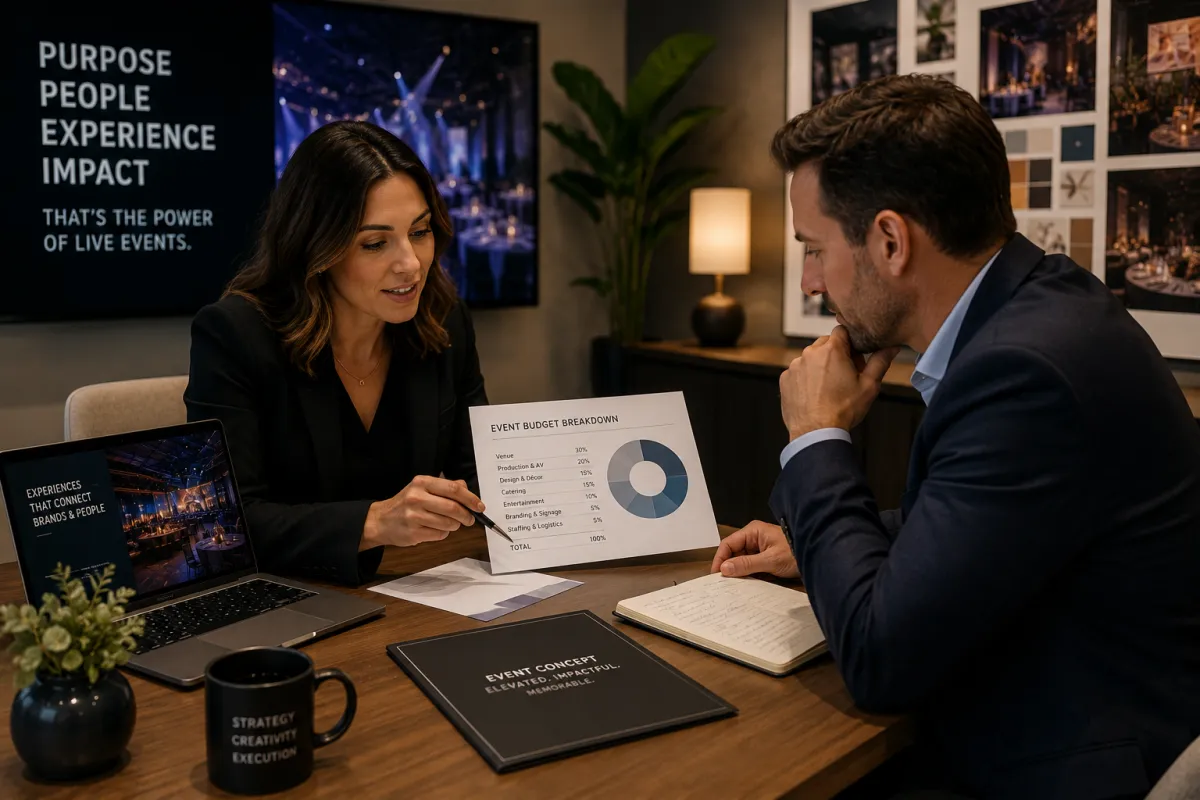
For a mid-range corporate event, here is a realistic picture of how budget tends to allocate.
Venue: 20 to 30 percent Venue is almost always the largest single line item, and it sets the ceiling for everything else. The venue determines your catering minimums, your production constraints, your load-in windows, and in some cases your vendor list. Choosing the venue is not just a real estate decision. It is a strategic one.
Catering and beverage: 25 to 35 percent Food and beverage costs are driven by guest count, service style, and menu complexity. Seated plated dinners cost more than stations. Open bars cost more than beer and wine. Dietary accommodations add complexity that adds cost.
Production and AV: 15 to 25 percent This is the category that surprises people most because it is often underestimated early in planning. Production includes staging, lighting, sound, screens and display technology, streaming infrastructure, and the labor to set it up and run it live. For events where the visual and sensory experience matters, this is not the place to cut.
Decor, environment design, and experiential elements: 10 to 20 percent This is where an event becomes an experience. Custom installations, branded environments, interactive activations, floral, lighting design beyond basic AV, furniture and lounge buildouts. Budget here is directly proportional to how immersive and memorable the event needs to be.
Staffing and event management: 10 to 15 percent This covers the on-site team, day-of coordination, vendor management, run-of-show execution, and the planning hours that happen in the months before the event. When you hire an experiential agency, this is also where strategy lives: the thinking that determines how all the other line items work together.
Miscellaneous and contingency: 5 to 10 percent Every event needs a contingency buffer. Industry standard is 10 percent. This covers last-minute vendor changes, scope adjustments, weather, and the unexpected moments that happen in live production regardless of how well you have planned.
What Fortune 500 Teams Should Know
When you are bringing in a corporate event planning company, you are not just buying logistics. You are buying expertise, vendor relationships, and the experience of someone who has solved these problems before at this level.
That means the question is not just what does this cost but what does this cost relative to what it delivers.
A well-produced executive retreat strengthens leadership alignment. A brand activation at a trade show generates qualified pipeline. A client appreciation event extends relationships that represent millions in revenue. The event is never just the event.
The planners and agencies who are worth what they charge understand that and build their proposals around it.
What a Realistic Budget Range Looks Like
Without knowing your specific event, these are general market benchmarks for corporate event planning in 2026.
Smaller corporate gatherings of 50 to 150 guests with moderate production typically run between $25,000 and $75,000.
Mid-size events of 150 to 400 guests with custom experience design typically run between $75,000 and $200,000.
Large-scale corporate productions of 400 or more guests or high-customization brand events often run $200,000 and above depending on scope.
These are planning benchmarks, not quotes. The actual number depends on your market, your timeline, your vendors, and the experience you are designing.
The Honest Bottom Line
Budget transparency is one of the most valuable things a corporate event planning partner can offer. If you are getting vague answers early in the conversation, that is information.
At HM Experiential, we build proposals around your business outcomes first and your budget second. That way the numbers make sense before we ever ask you to approve them.
If you are planning a corporate event and want to understand what your investment could actually look like, we would love to talk. Get in touch at hmexperiential.com/contact.